
Blenders
Blowtorches
Breadmakers
Coffee Grinders
Coffee Makers
Deep fryers & Airfryers
Food Cookers
Food Dehydrators
Food Mixers & Food Processors
Hand Blenders
Hand Mixers
Ice Cream Makers
Ice Makers
Juicers
Kettles
Kitchen Scales
Meat Slicers
Mincers
Mini Choppers & Spiralisers
Other Kitchen Appliances
Pasta Makers
Popcorn Makers
Sandwich Toasters
Soft Drink Makers
Toasters
Vacuum Sealers
Waffle Makers

Bamix Hand Blenders
Try flexible payments withLearn how
26 products


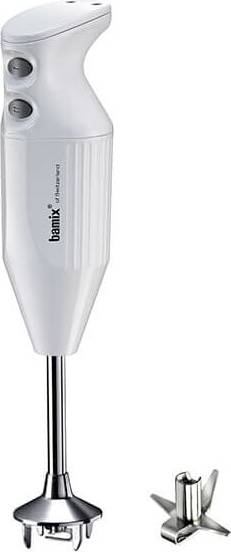


Hand Blenders: 3 things to consider before buying
When choosing hand blenders, it's important to consider both power and speed settings. Power is measured in watts, and a higher wattage generally means the blender can handle tougher ingredients like nuts or frozen fruits with ease. Look for hand blenders with at least 200 watts for basic tasks, but if you plan to blend harder substances, aim for 500 watts or more. Speed settings offer flexibility; multiple speeds allow you to control the blending process more precisely. For instance, slower speeds are ideal for delicate tasks like whisking cream, while high speeds work best for pureeing soup.
Hand blenders often come with various attachments that can enhance their versatility. Common accessories include whisks, chopping bowls, and beakers. A whisk attachment is perfect for whipping cream or egg whites, while a chopping bowl can help with dicing onions or herbs. A beaker is useful for blending smoothies directly without additional mess. Consider what tasks you'll frequently perform in your kitchen and choose a hand blender that includes the attachments you need.
The design of hand blenders significantly impacts their usability. Look for models with an ergonomic grip to ensure comfort during extended use. A non-slip handle provides better control, especially when dealing with wet or greasy hands. Additionally, consider how easy it is to clean the appliance. Detachable blending arms that are dishwasher safe make cleaning much simpler. If you prefer hand washing, look for smooth surfaces without too many crevices where food particles might get stuck.
FAQ
Hand blenders are versatile kitchen tools for blending, pureeing, and mixing. They help you create soups, smoothies, and sauces effortlessly. With their compact design, they offer convenience and easy storage. Consider the power and attachments to match your cooking needs.
Hand blenders are chosen based on power, attachments, and ease of use. Look for a comfortable grip and dishwasher-safe parts. Decide if you need additional features like whisk or chopper attachments to suit your culinary tasks.
Hand blenders are generally easy to clean due to detachable parts. Most models have dishwasher-safe components, making maintenance straightforward. Ensure the motor unit stays dry by wiping it with a damp cloth.
Hand blenders are portable and ideal for small batches directly in pots or bowls. Traditional blenders have larger capacities suitable for bulk blending. Choose based on your space and volume needs.
Hand blenders can crush ice if they have a powerful motor and robust blades. Check the product specifications before attempting this task to avoid damaging the appliance.
Borrowing more than you can afford or paying late may negatively impact your financial status and ability to obtain credit. Credit subject to status. Ts&Cs and late fees apply.
Advertisement
Popular searches in Hand Blenders
- Bosch serie 6 dishwasher
- Braun multiquick 5
- Bamix blender
- 1000w bosch hand blender
- Bosch chopper and blender
- Braun blender hand
- Braun multiquick
- Braun blender
- 5237
- Kenwood blender hand
- Braun multiquick 7
- Bosch 1000w
- Bosch msm
- Hand blender bosch
- Braun 1000w
- Russell hobbs desire
- Foot pro
- Electric potato masher
- Commercial blender
- Cordless Hand Blenders
- Braun Hand Blenders
- Hand Blenders on sale
- KitchenAid Hand Blenders
- Smeg Hand Blenders
- Bosch Hand Blenders
- Ninja Hand Blenders
- Stainless Steel Hand Blenders
- Tefal Hand Blenders
- Kenwood Hand Blenders
- Mashers Hand Blenders
- Russell Hobbs Hand Blenders
- Moulinex Hand Blenders
- Ice Crushers Hand Blenders
- Charging Units - Cordless Hand Blenders
- Philips Hand Blenders
- Stainless Steel Foot Hand Blenders on sale
- Braun Hand Blenders on sale
- Adjustable Speeds Hand Blenders
- Whisks Hand Blenders
- Cuisinart Hand Blenders
Borrowing more than you can afford or paying late may negatively impact your financial status and ability to obtain credit. Credit subject to status. Ts&Cs and late fees apply.